 Courses
Undergraduate course · 1 lecture
Databases
An introduction to databases and database management systems.
Information Science · Digital Knowledge
Courses & talks
Courses and their lectures, and public talks at conferences and events
CoursesUndergraduate course · 1 lecture
An introduction to databases and database management systems.
 Courses
Undergraduate course · 9 lectures
An introductory course in object-oriented programming with Visual Basic .NET and its integrated development environment, with hands-on exercises.
 Courses
Undergraduate course · 16 lectures
A course covering computer network concepts, physical architecture, devices and protocols, as well as the components and services of the Internet and its applications in libraries.
 Courses
Undergraduate course · 10 lectures
Department of Library and Information Science, Faculty of Arts (2004–2005)
The course covers reference service in its modern forms and specialized sources, and the principles of providing and evaluating reference (question-answering) services. Co-taught with Dr. Amgad Abdel Hady El-Gohary.
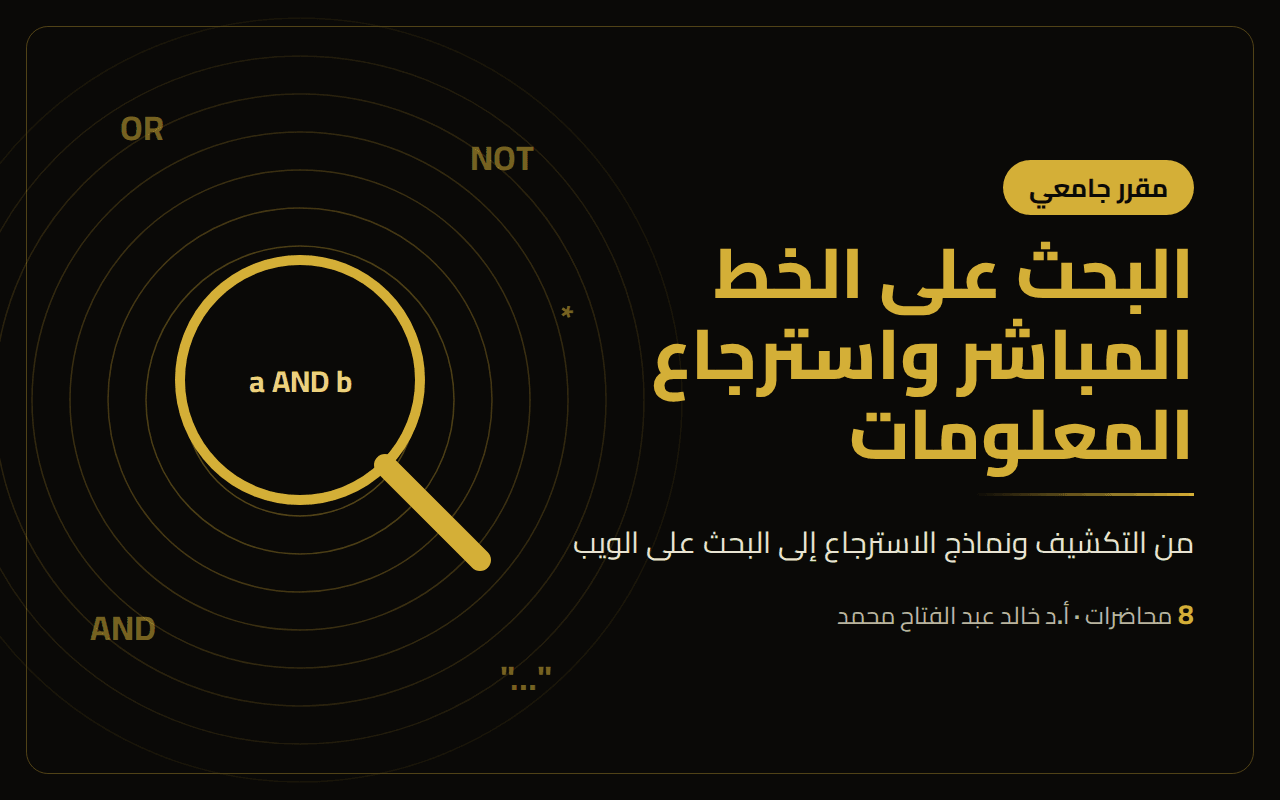 Courses
Undergraduate course · 8 lectures
A course covering the fundamentals of information retrieval, indexing, retrieval system models and web search techniques.
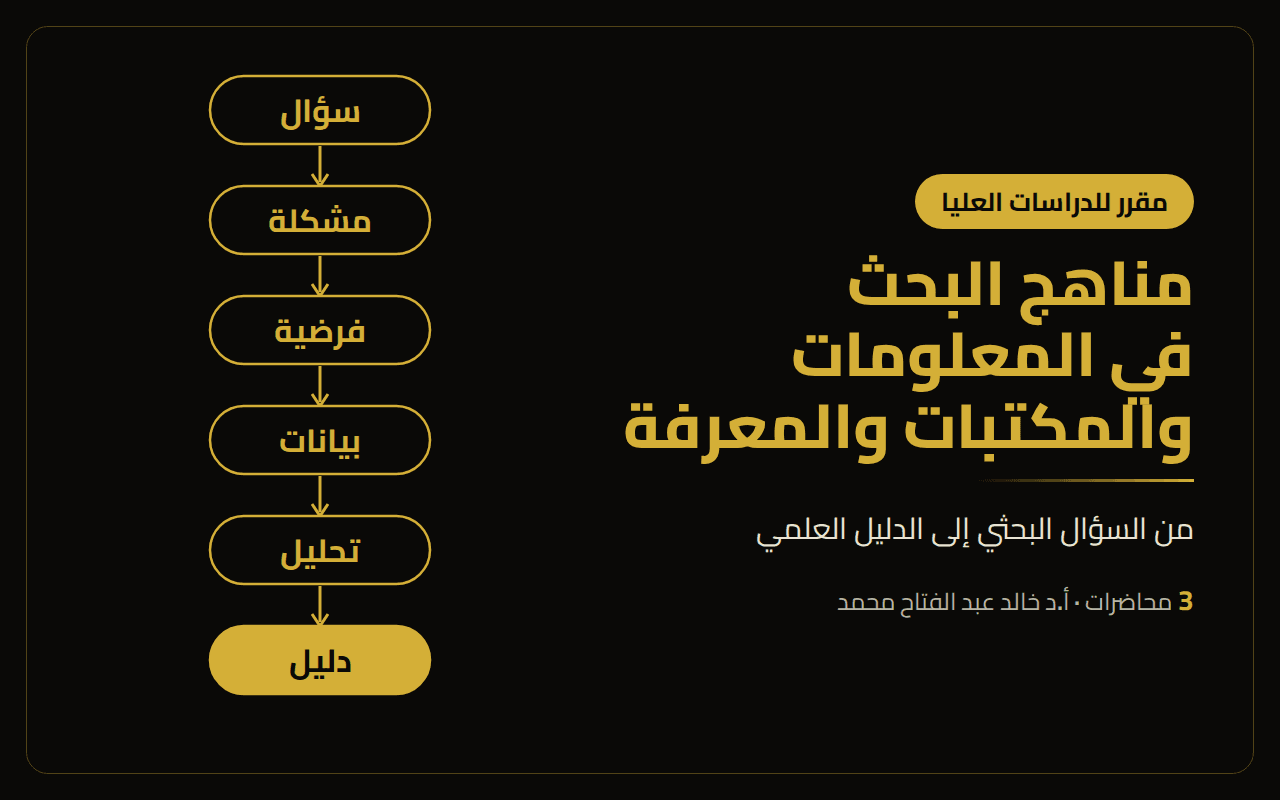 Courses
Postgraduate course · 3 lectures
A course that guides the researcher from the research question to scientific evidence: research methods and types, research ethics in the age of artificial intelligence, problem formulation, and data analysis.
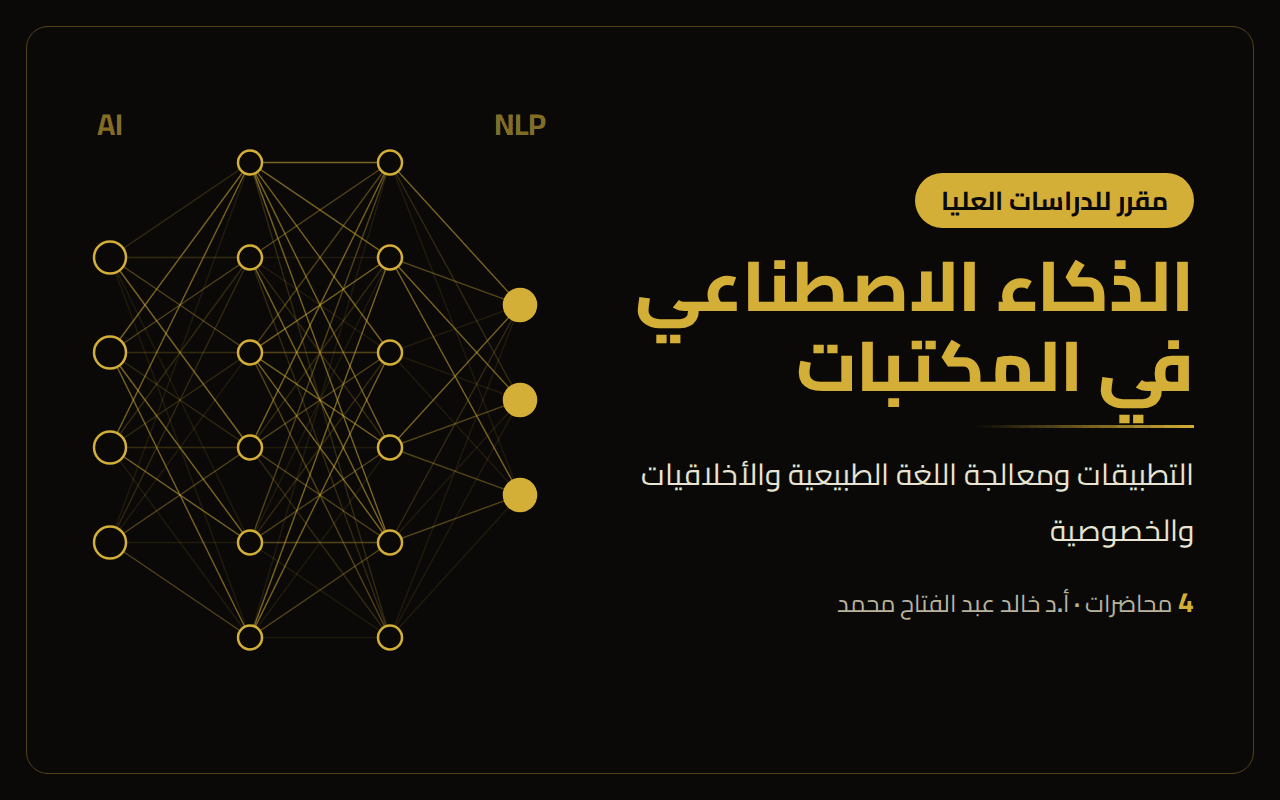 Courses
Postgraduate course · 4 lectures
A course covering applications of artificial intelligence in libraries and information institutions, natural language processing, the assessment of ethical, legal and user-privacy risks, and the impact of AI on knowledge representation and access.
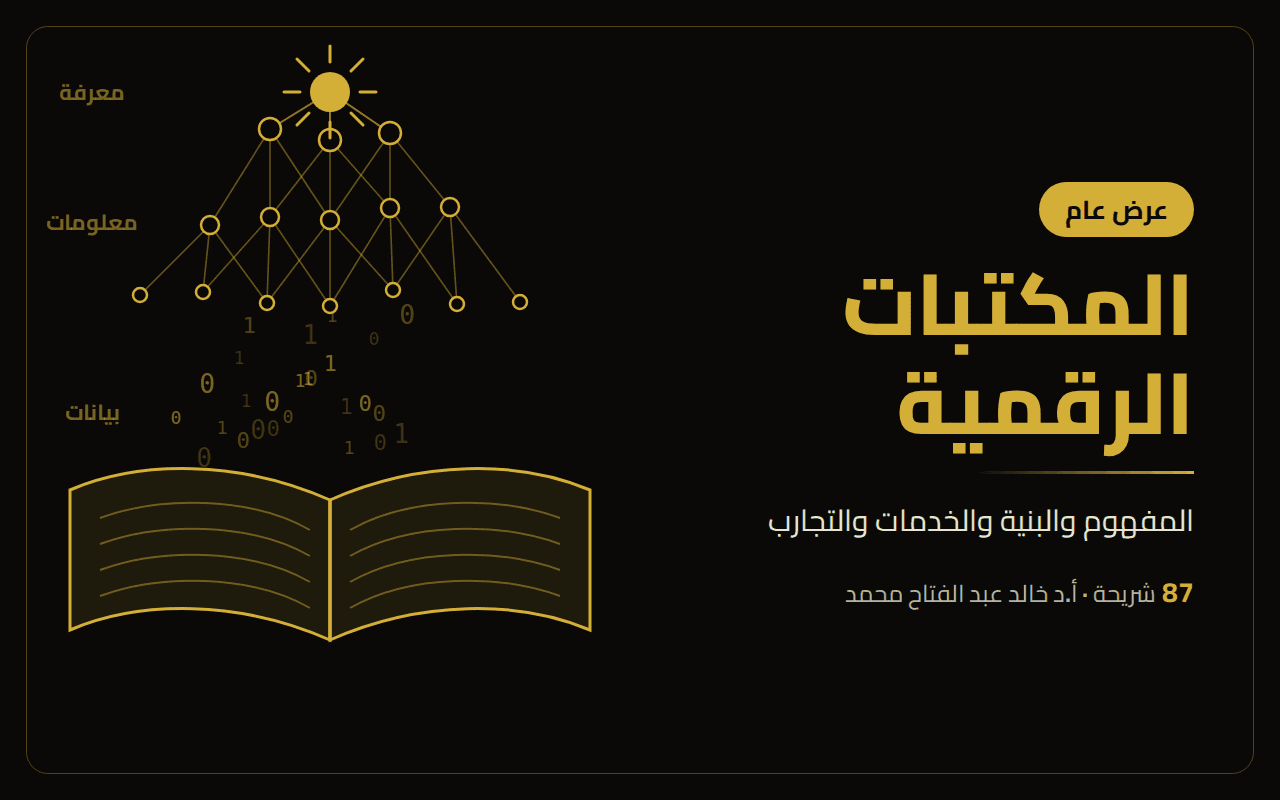 Talks
Public presentation · 87 slides
A comprehensive overview of the concept of digital libraries, their vision, components, services and experiences.
 Talks
Public presentation · 65 slides
A presentation in English: terminology and definitions, the economic, technological and environmental drivers for establishing digital libraries, their role, and emerging technologies.
 Talks
Public presentation · 41 slides · 2014
The general framework of information retrieval: information processing, retrieval systems, methods and techniques, linguistic patterns, evaluation and measurement, and future trends.
 Talks
Public presentation · 52 slides
Reengineering administrative processes in Egyptian university libraries to improve performance, measured by indicators of cost, quality, service and speed.
 Talks
Public presentation · 47 slides
Metadata: its nature and importance, and the standards and applications used in processing government information resources, including the Government Information Locator Service, archival description, visual resources and the Resource Description Framework.
 Talks
Public presentation · 16 slides
Information institutions and their types, e-learning, core skills, and integration between information platforms and learning platforms.
 Talks
Public presentation · 54 slides
A workshop on knowledge, how it is acquired and managed, the Asian Productivity Organization (APO) knowledge management framework and its measurement levels, with the Digital Knowledge Hub as an applied model.
 Talks
Public presentation · 23 slides · 2026
The Digital Knowledge Hub as a comprehensive Arabic knowledge platform: an incubator for Arabic content, solutions for processing it from data to knowledge, a training centre, and a tool for the digital transformation of individuals and institutions.
 Talks
Public presentation · 30 slides
An integrated model for building the knowledge persona, grounded in the 'Iqra' (Read) verses of Surat al-Alaq: the concept of awareness and its levels, from reading awareness (reading, comprehension and recall) to information, educational, media and scientific awareness.
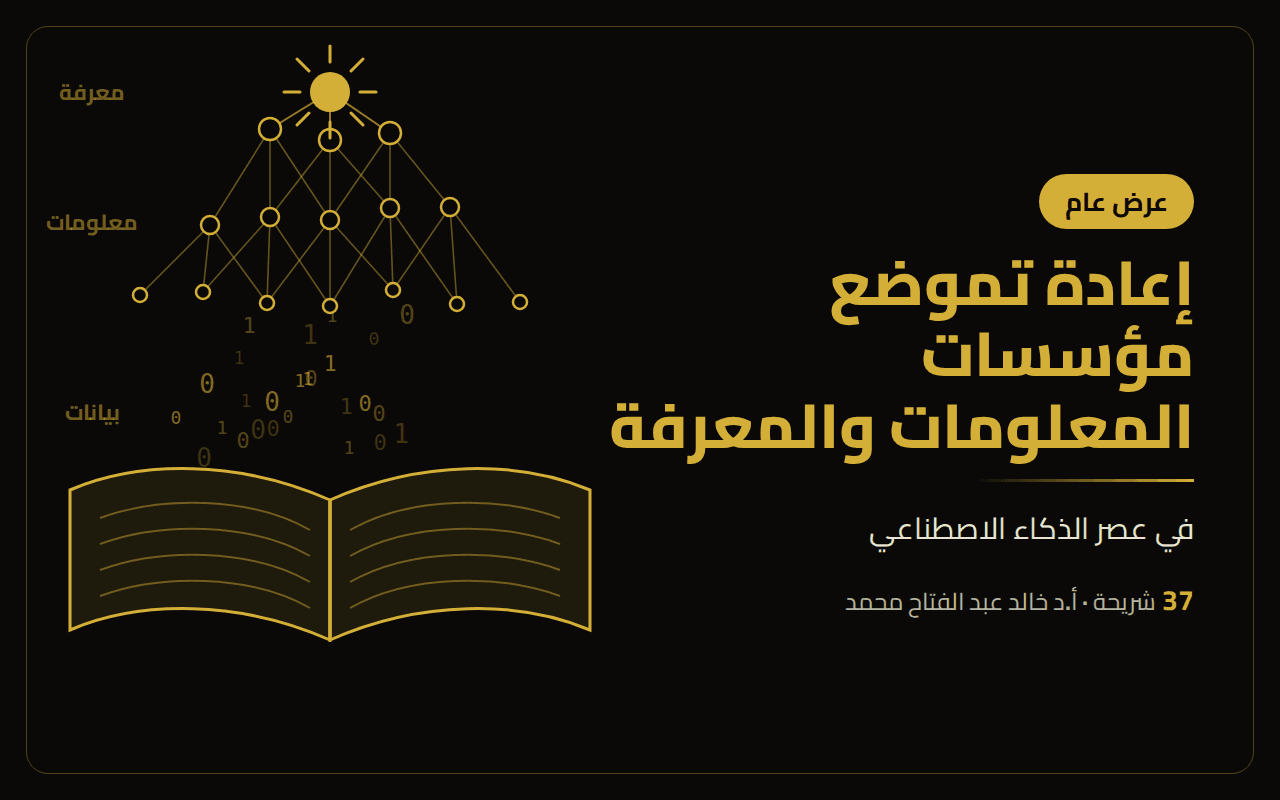 Talks
Public presentation · 37 slides
Why do information and knowledge institutions need to reposition themselves? The governing knowledge question, the model of the new institution, intelligent services and processes, curricula and skills, governance and trust, and an implementation roadmap.